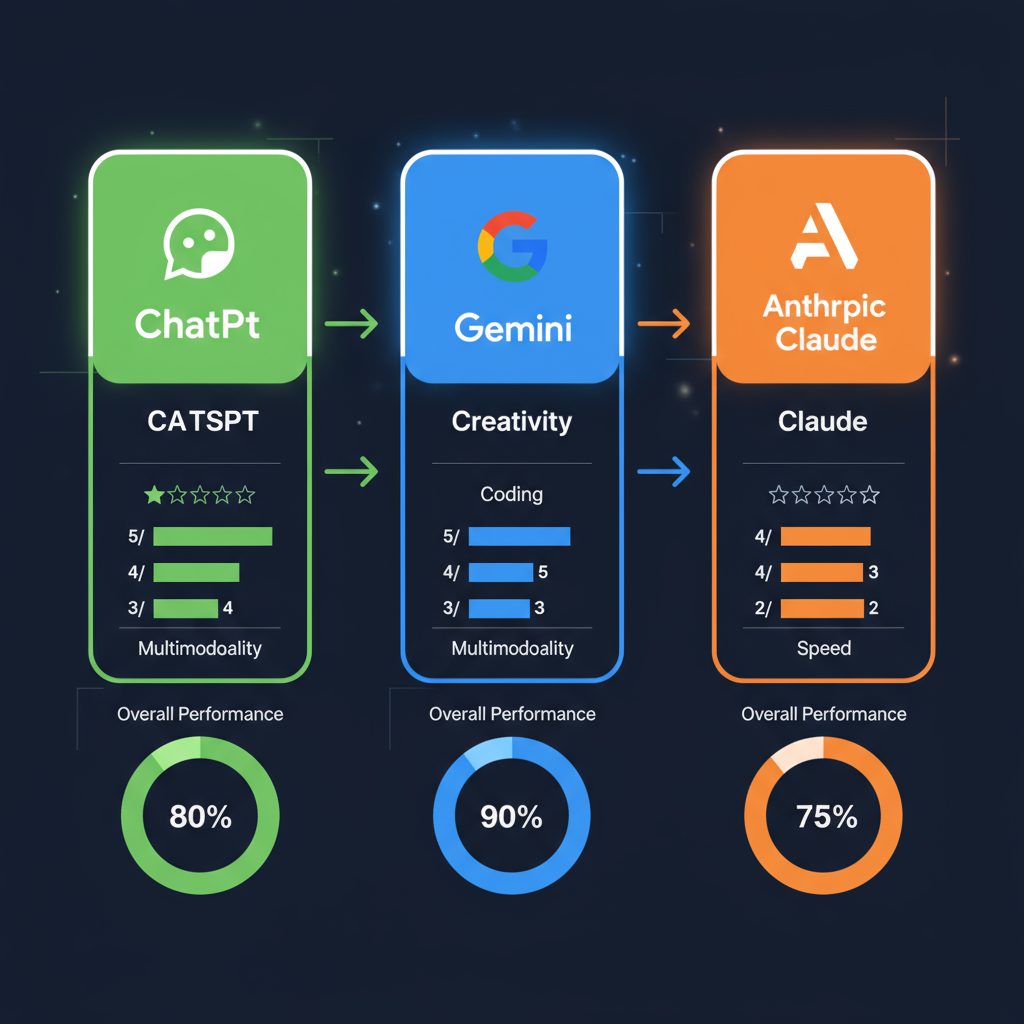
Choosing the right AI model can make or break your prompt engineering success. With ChatGPT, Google Gemini, and Anthropic Claude all offering unique strengths, how do you know which one to use for your specific needs?
The answer isn’t simple—each model excels in different areas, and the “best” choice depends entirely on your use case, budget, and requirements. After extensive testing across hundreds of prompts and scenarios, we’ve compiled this comprehensive comparison to help you make informed decisions.
This isn’t about declaring a winner. Instead, we’ll show you exactly when to use each model, how to optimize prompts for their specific strengths, and how to get the best results from each platform.
Whether you’re writing content, analyzing data, coding, or solving complex problems, this guide will help you choose the right AI model for every situation.
Understanding the Contenders
Before diving into specific comparisons, let’s understand what makes each model unique:
ChatGPT (OpenAI)
Strengths: Conversational ability, creative writing, general knowledge, plugin ecosystem Best for: Content creation, brainstorming, general assistance, coding help Weaknesses: Can be verbose, sometimes lacks precision in technical tasks Pricing: Free tier available, Plus subscription for GPT-4 access
Google Gemini
Strengths: Real-time information access, Google integration, multimodal capabilities Best for: Research, current events, data analysis, Google Workspace integration Weaknesses: Newer model with evolving capabilities, limited customization Pricing: Free tier available, paid plans for advanced features
Anthropic Claude
Strengths: Safety-focused, excellent reasoning, precise following of instructions Best for: Analysis, research, complex reasoning, safety-critical applications Weaknesses: More conservative responses, limited real-time information Pricing: Free tier available, Pro subscription for extended usage
Head-to-Head Comparisons
Let’s examine how each model performs across key prompt engineering scenarios:
Content Creation and Writing
The Test: Create a 500-word blog post about sustainable technology trends.
ChatGPT Performance:
- Creativity: Excellent - generates engaging, varied content
- Structure: Good - follows requested format well
- Tone: Very adaptable - easily matches requested voice
- Speed: Fast response times
- Best prompt approach: Detailed role-playing and context setting
Sample ChatGPT Prompt:
You are a tech journalist writing for a sustainability-focused publication. Write a 500-word blog post about emerging sustainable technology trends that will impact businesses in 2025. Use an engaging, optimistic tone and include specific examples.Gemini Performance:
- Creativity: Good - solid content with current information
- Structure: Excellent - very organized output
- Tone: Consistent but sometimes formal
- Speed: Fast with real-time data integration
- Best prompt approach: Clear, structured requests with specific requirements
Sample Gemini Prompt:
Create a 500-word blog post about sustainable technology trends for 2025. Include:
1. Current market data
2. 3 specific technology examples
3. Business impact analysis
4. Future predictions
Format with clear headings and bullet points.
Claude Performance:
- Creativity: Good - thoughtful, well-reasoned content
- Structure: Excellent - highly organized and logical
- Tone: Professional and measured
- Speed: Moderate response times
- Best prompt approach: Detailed instructions with clear constraints
Sample Claude Prompt:
Write a 500-word blog post analyzing sustainable technology trends for business leaders. Focus on evidence-based insights and practical implications. Structure: introduction, 3 main trends with examples, conclusion with actionable recommendations. Maintain a professional, analytical tone throughout.Winner for Content Creation: ChatGPT for creative content, Claude for analytical pieces, Gemini for data-driven articles.
Technical Analysis and Problem Solving
The Test: Analyze a complex business problem and provide strategic recommendations.
ChatGPT Performance:
- Analysis depth: Good - covers multiple angles
- Logical reasoning: Solid but can be inconsistent
- Practical recommendations: Strong - actionable advice
- Creativity in solutions: Excellent - thinks outside the box
Gemini Performance:
- Analysis depth: Very good - incorporates current data
- Logical reasoning: Strong - systematic approach
- Practical recommendations: Good - data-backed suggestions
- Creativity in solutions: Moderate - tends toward conventional approaches
Claude Performance:
- Analysis depth: Excellent - thorough and comprehensive
- Logical reasoning: Outstanding - highly systematic and logical
- Practical recommendations: Very strong - well-reasoned advice
- Creativity in solutions: Good - balanced and thoughtful
Winner for Analysis: Claude for complex reasoning, Gemini for data-heavy analysis, ChatGPT for creative problem-solving.
Code Generation and Programming
The Test: Create a Python script for data processing with error handling.
ChatGPT Performance:
- Code quality: Good - functional but sometimes verbose
- Best practices: Moderate - doesn’t always follow conventions
- Error handling: Basic - covers common scenarios
- Documentation: Good - includes helpful comments
Gemini Performance:
- Code quality: Very good - clean and efficient
- Best practices: Strong - follows modern conventions
- Error handling: Good - comprehensive coverage
- Documentation: Excellent - detailed explanations
Claude Performance:
- Code quality: Excellent - clean, efficient, well-structured
- Best practices: Outstanding - follows industry standards
- Error handling: Excellent - robust and comprehensive
- Documentation: Very good - clear and thorough
Winner for Coding: Claude for production code, Gemini for learning and documentation, ChatGPT for quick prototypes.
Research and Information Gathering
The Test: Research current market trends in renewable energy.
ChatGPT Performance:
- Information accuracy: Good but limited to training data
- Source variety: Limited - no real-time access
- Synthesis ability: Excellent - great at connecting ideas
- Presentation: Very good - engaging format
Gemini Performance:
- Information accuracy: Excellent - access to current data
- Source variety: Outstanding - real-time web access
- Synthesis ability: Good - systematic compilation
- Presentation: Good - well-organized output
Claude Performance:
- Information accuracy: Good but limited to training data
- Source variety: Limited - no real-time access
- Synthesis ability: Excellent - superior analysis and reasoning
- Presentation: Excellent - highly structured and clear
Winner for Research: Gemini for current information, Claude for analysis of existing data, ChatGPT for creative synthesis.
Model-Specific Prompt Optimization
Each model responds best to different prompting approaches:
ChatGPT Optimization Strategies
Use Role-Playing:
You are a [specific role] with [relevant experience]. Your task is to [specific objective] for [target audience].Provide Rich Context:
Background: [detailed context]
Objective: [clear goal]
Audience: [specific details]
Constraints: [limitations]
Encourage Creativity:
Think creatively and provide multiple perspectives on [topic]. Consider unconventional approaches and innovative solutions.Gemini Optimization Strategies
Structure Your Requests:
Task: [clear objective]
Requirements:
1. [requirement 1]
2. [requirement 2]
3. [requirement 3]
Format: [specific output format]
Leverage Real-Time Data:
Research the latest information about [topic] and provide current statistics, trends, and developments from [time period].Use Clear Formatting:
Organize your response with:
- Clear headings
- Bullet points for key information
- Numbered lists for sequential steps
- Tables for data comparison
Claude Optimization Strategies
Be Extremely Specific:
Analyze [specific topic] by examining [specific aspects]. Provide [number] recommendations based on [specific criteria]. Each recommendation should include [specific elements].Use Logical Structure:
Approach this systematically:
1. First, analyze [aspect 1]
2. Then, examine [aspect 2]
3. Finally, synthesize findings into [deliverable]
Set Clear Constraints:
Guidelines:
- Focus on [specific scope]
- Avoid [specific exclusions]
- Prioritize [specific criteria]
- Maintain [specific tone/style]
Use Case Recommendations
Based on our testing, here’s when to use each model:
Choose ChatGPT When:
- Creative writing projects (blogs, stories, marketing copy)
- Brainstorming sessions (idea generation, problem-solving)
- Conversational interfaces (chatbots, customer service)
- Quick content generation (social media, emails, summaries)
- Learning and education (explanations, tutoring, examples)
Choose Gemini When:
- Research projects requiring current information
- Data analysis with real-time components
- Google Workspace integration (Docs, Sheets, Gmail)
- Market research and competitive analysis
- News and current events analysis
- Fact-checking and verification
Choose Claude When:
- Complex analysis requiring deep reasoning
- Safety-critical applications (healthcare, finance, legal)
- Technical documentation and specifications
- Code review and quality assurance
- Academic research and scholarly writing
- Detailed planning and strategy development
Multi-Model Strategies
Sometimes the best approach is using multiple models together:
Sequential Processing
- Research with Gemini - gather current information
- Analyze with Claude - deep reasoning and synthesis
- Create with ChatGPT - engaging final content
Parallel Validation
- Generate content with one model
- Fact-check with Gemini
- Review logic with Claude
- Optimize creativity with ChatGPT
Specialized Workflows
- Content creation: ChatGPT for drafts, Claude for editing, Gemini for fact-checking
- Business analysis: Gemini for data, Claude for analysis, ChatGPT for presentation
- Technical projects: Claude for architecture, ChatGPT for documentation, Gemini for current best practices
Cost and Performance Considerations
Free Tier Limitations
- ChatGPT: Limited GPT-4 access, slower responses during peak times
- Gemini: Usage caps, reduced features
- Claude: Message limits, no priority access
Paid Plan Benefits
- ChatGPT Plus: GPT-4 access, faster responses, plugin ecosystem
- Gemini Advanced: Higher usage limits, advanced features
- Claude Pro: Extended conversations, priority access
ROI Considerations
- High-volume content: ChatGPT often most cost-effective
- Research-heavy work: Gemini’s real-time access saves time
- Quality-critical tasks: Claude’s precision reduces revision cycles
Future-Proofing Your Prompt Strategy
The AI landscape evolves rapidly. Here’s how to stay adaptable:
Model-Agnostic Prompting
Design prompts that work across models:
Role: [specific expertise]
Task: [clear objective]
Context: [relevant background]
Format: [desired output]
Constraints: [limitations]
Regular Testing
- Test key prompts across all models monthly
- Track performance changes over time
- Adapt strategies as models improve
Diversification Strategy
- Don’t rely on a single model
- Maintain accounts across platforms
- Develop expertise in multiple approaches
Practical Implementation Guide
Week 1: Assessment
- Audit your current AI usage - identify primary use cases
- Test each model with your most common prompts
- Document performance differences for your specific needs
- Choose primary and backup models for each use case
Week 2: Optimization
- Refine prompts for each chosen model
- Create model-specific templates for common tasks
- Establish quality benchmarks for different outputs
- Train team members on model-specific approaches
Week 3: Integration
- Implement multi-model workflows where beneficial
- Set up monitoring systems for quality and cost
- Create decision trees for model selection
- Establish feedback loops for continuous improvement
Week 4: Scaling
- Document best practices and lessons learned
- Create training materials for broader team adoption
- Plan for future model releases and updates
- Establish governance policies for model usage
The Bottom Line: Strategic Model Selection
There’s no universal “best” AI model—only the best model for your specific situation. Success in prompt engineering comes from understanding each model’s strengths and matching them to your needs.
For most users, we recommend:
- Primary model: Choose based on your most frequent use case
- Secondary model: Select for specialized tasks where your primary model is weak
- Research model: Always have access to Gemini for current information
The key is flexibility. As these models continue to evolve, the best prompt engineers will be those who can adapt their strategies and leverage the unique strengths of each platform.
Ready to optimize your AI model selection? Try Promptmakers to test your prompts across multiple models, track performance, and build a library of optimized templates for each platform. With side-by-side comparisons and performance analytics, you’ll quickly discover which models work best for your specific needs.