You’ve probably experienced this: you spend time crafting what seems like a good prompt, but the AI’s response misses the mark. Maybe it’s too generic, off-topic, or just not quite what you had in mind. The frustration is real, and it’s usually not the AI’s fault—it’s a communication problem.
That’s why we developed the CLEAR framework. It’s a systematic approach to prompt engineering that ensures your instructions are understood correctly and executed effectively, every single time.
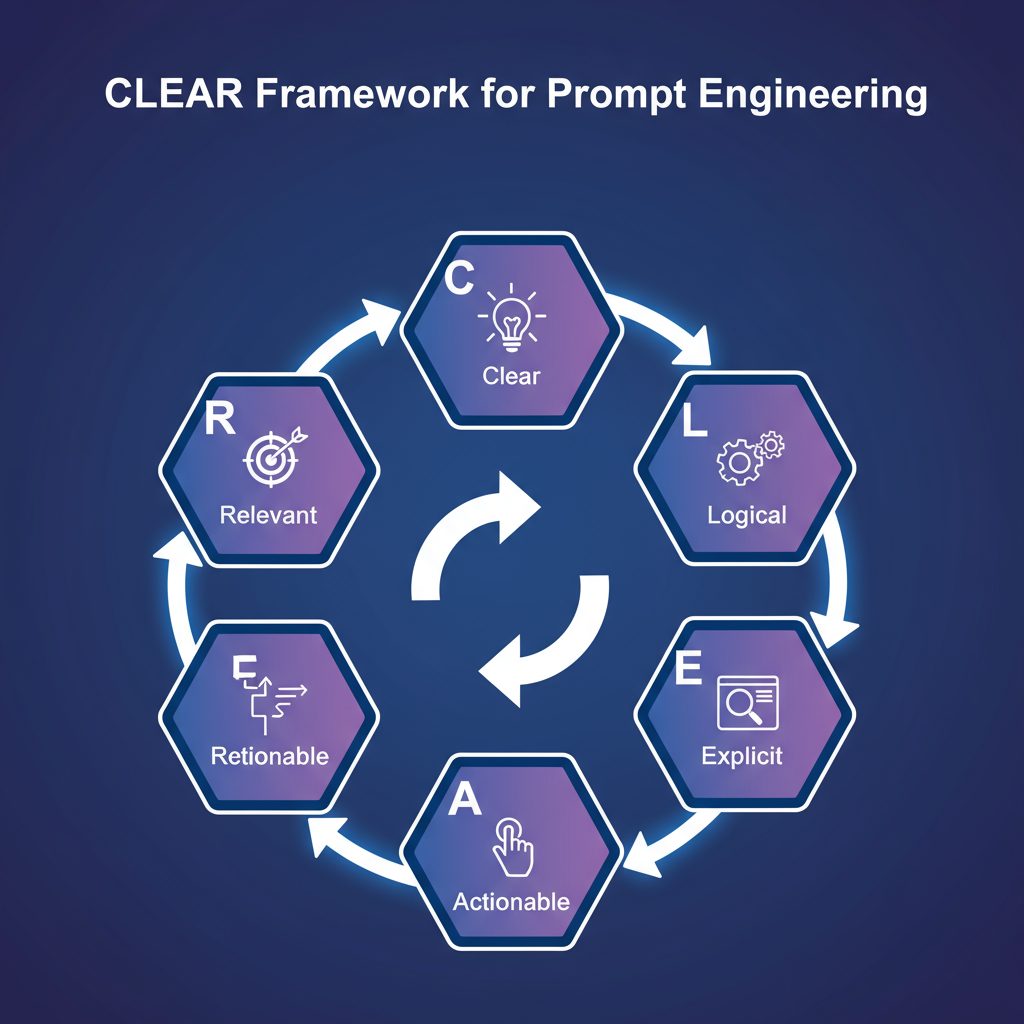
CLEAR stands for Clear, Logical, Explicit, Actionable, and Relevant. Think of it as your blueprint for building prompts that work.
In this deep dive, we’ll explore each element of the framework with practical examples, common pitfalls to avoid, and advanced techniques to maximize your results.
C - Clear: Eliminate Ambiguity
The foundation of any good prompt is clarity. Ambiguous language is the enemy of good AI output. Every word in your prompt should have a clear, specific meaning.
The Problem with Vague Language
Consider this prompt: “Write something good about productivity.”
What’s wrong here?
- “Something” could be anything—an article, a tweet, a book chapter
- “Good” is subjective—good for whom? In what way?
- “About productivity” is too broad—which aspect of productivity?
The Clear Alternative
Here’s how to make it clear:
Write a 600-word blog post explaining three evidence-based productivity techniques that busy professionals can implement immediately to reduce daily stress and increase output.Why this works:
- Specific format: “600-word blog post”
- Clear scope: “three evidence-based productivity techniques”
- Defined audience: “busy professionals”
- Specific outcome: “reduce daily stress and increase output”
- Implementation timeframe: “immediately”
Clarity Checklist
Before submitting any prompt, ask yourself:
- Could someone else read this and understand exactly what I want?
- Are there any words that could be interpreted multiple ways?
- Have I specified the format, length, and style I want?
- Is my desired outcome crystal clear?
L - Logical: Structure Your Thinking
Logical prompts follow a natural flow that makes sense to both you and the AI. They’re organized in a way that builds understanding step by step.
The Power of Sequential Thinking
Poor structure confuses AI models. When information is scattered or presented out of order, the AI has to guess at your priorities and intentions.
Illogical prompt:
Write about email marketing and include metrics and make it for small businesses but also talk about automation and don't forget to mention deliverability issues and keep it under 500 words.Logical prompt:
Write a 500-word guide to email marketing for small businesses.

Structure:
1. Introduction: Why email marketing matters for small businesses
2. Key metrics to track (open rates, click rates, conversions)
3. Automation basics for beginners
4. Common deliverability issues and solutions
5. Conclusion with next steps

Target audience: Small business owners with limited marketing experience.
Building Logical Flow
Use these techniques to create logical structure:
Hierarchical Organization:
- Start with the big picture
- Break down into main sections
- Provide specific details within each section
Sequential Steps:
- Use numbered lists for processes
- Follow chronological order when relevant
- Build complexity gradually
Priority-Based Structure:
- Lead with the most important information
- Use phrases like “First,” “Most importantly,” “Additionally”
E - Explicit: Leave Nothing to Chance
Explicit prompts spell out exactly what you want, leaving no room for assumptions. This is where many prompt writers fail—they assume the AI knows what they mean.
The Assumption Trap
Implicit prompt:
Write a product description for our new app.What’s missing?
- What kind of app is it?
- Who’s the target audience?
- What’s the tone and style?
- How long should it be?
- What key features should be highlighted?
- Where will this description be used?
Explicit prompt:
Write a 150-word product description for our new project management mobile app.

Product details:
- Name: TaskFlow Pro
- Target audience: Freelancers and small teams (2-10 people)
- Key features: Real-time collaboration, time tracking, client invoicing
- Unique selling point: Works offline and syncs when connected

Usage: This will appear on the App Store and Google Play Store.

Tone: Professional but approachable, emphasizing ease of use and reliability.

Include:
- A compelling opening hook
- 3 main benefits (not just features)
- A clear call-to-action
- Relevant keywords for app store optimization
Explicit Elements Checklist
Make sure your prompts explicitly include:
- Context: Background information the AI needs
- Constraints: Word limits, style requirements, what to avoid
- Format: How you want the output structured
- Audience: Who this is for and their characteristics
- Purpose: What you’ll use this output for
- Success criteria: How you’ll know if the output is good
A - Actionable: Focus on Specific Tasks
Actionable prompts give the AI concrete tasks to perform rather than abstract concepts to explore. They use action verbs and specific instructions.
From Abstract to Actionable
Abstract prompt:
Think about customer service.Actionable prompt:
Create a 5-step customer service recovery process for handling angry customers who received damaged products. Include specific scripts for each step and explain the psychology behind each approach.Action Verb Power
Start your prompts with strong action verbs:
- Create: “Create a social media content calendar…”
- Analyze: “Analyze this sales data and identify…”
- Compare: “Compare these three marketing strategies…”
- Develop: “Develop a training program for…”
- Optimize: “Optimize this email subject line for…”
Making Tasks Specific
Instead of general requests, break down what you want into specific, measurable tasks:
General: “Help me with my presentation.” Specific: “Create an outline for a 15-minute presentation about renewable energy trends, including 5 main points, suggested visuals for each point, and talking points that will engage a non-technical audience.”
R - Relevant: Align with Your Goals
Relevant prompts connect directly to your specific situation, goals, and constraints. They consider your unique context rather than asking for generic advice.
Context is King
The same request can have completely different optimal solutions depending on context:
Generic prompt:
How do I improve my website's SEO?Relevant prompt:
I run a local bakery in Portland, Oregon. My website gets 200 visitors per month, mostly from Google searches for "birthday cakes Portland." I want to attract more customers searching for wedding cakes and custom desserts.

My constraints:
- Limited budget ($200/month for marketing)
- No technical skills for complex website changes
- Competing with 15+ other bakeries in the area

Provide 5 specific, actionable SEO improvements I can implement myself within the next month to target wedding cake searches.
Relevance Factors to Consider
- Industry/niche specifics
- Company size and resources
- Geographic location
- Target audience characteristics
- Budget constraints
- Timeline requirements
- Existing tools and systems
- Skill level and expertise
Putting CLEAR Into Practice
Let’s see the CLEAR framework in action with a complete example:
Before CLEAR:
Write a marketing email.After CLEAR:
Clear: Specific format and purpose defined Logical: Structured with clear sections Explicit: All necessary details provided Actionable: Concrete tasks specified Relevant: Tailored to specific business context
Write a promotional email to re-engage customers who haven't purchased from our online fitness equipment store in the past 6 months.

Email specifications:
- Subject line + 200-word body
- Tone: Encouraging and motivational, not pushy
- Offer: 25% discount on home gym equipment

Customer context:
- Previous buyers of basic equipment (resistance bands, yoga mats)
- Likely interested in upgrading to larger equipment
- May have lapsed due to motivation issues, not satisfaction problems

Email structure:
1. Personal greeting acknowledging their previous purchase
2. Motivational message about fitness journey continuation
3. Introduction of new/upgraded equipment
4. Clear discount offer with urgency (7-day limit)
5. Social proof (customer success stories)
6. Clear call-to-action button

Goals:
- 15% open rate minimum
- 3% click-through rate
- Warm, personal tone that rebuilds connection
Advanced CLEAR Techniques
Once you’ve mastered the basics, try these advanced applications:
Layered Clarity
Build prompts in layers, starting broad and getting specific:
Create a content marketing strategy for a B2B software company.

Layer 1 - Company context: [detailed background]
Layer 2 - Audience analysis: [specific buyer personas]
Layer 3 - Content requirements: [formats, frequency, topics]
Layer 4 - Success metrics: [specific KPIs and goals]
Conditional Logic
Use if-then statements for complex scenarios:
Analyze this customer feedback and categorize it. If the feedback mentions pricing, tag it as "pricing concern." If it mentions features, tag it as "feature request." If it's positive overall, tag it as "testimonial candidate."Progressive Refinement
Start with a CLEAR prompt, then refine based on output:
First, create a basic outline for this topic.
[Review output]
Now, expand section 3 with specific examples and data.
[Review output]
Finally, add transition sentences between all sections.
Common CLEAR Framework Mistakes
Even when trying to use CLEAR, people often make these mistakes:
Mistake 1: Over-Clarification
Problem: Making prompts so detailed they become confusing Solution: Find the balance between specific and concise
Mistake 2: Logical Overload
Problem: Creating overly complex structures Solution: Keep structure simple and intuitive
Mistake 3: Explicit Overkill
Problem: Including irrelevant details Solution: Include only information that affects the output
Mistake 4: Action Without Purpose
Problem: Giving tasks without explaining why Solution: Connect actions to desired outcomes
Mistake 5: Irrelevant Relevance
Problem: Including context that doesn’t matter Solution: Focus on context that actually changes the approach
Building Your CLEAR Prompt Library
The CLEAR framework becomes even more powerful when you create reusable templates:
Template Structure:
[CLEAR PROMPT TEMPLATE NAME]

Clear: [Specific format and outcome]
Logical: [Structure outline]
Explicit: [Key details to include]
Actionable: [Specific tasks]
Relevant: [Context variables to customize]

Template:
[Your reusable prompt with variables]
Example Template:
CONTENT CREATION TEMPLATE

Clear: Create [content type] of [length] about [topic]
Logical: Introduction → Main points → Conclusion
Explicit: Target audience, tone, key messages, constraints
Actionable: Write, structure, include, optimize
Relevant: Industry context, audience needs, business goals

Template:
Write a [length] [content type] about [topic] for [audience].

Context: [relevant background]
Tone: [desired tone]
Structure: [outline]
Include: [specific requirements]
Avoid: [constraints]
Goal: [desired outcome]
Measuring CLEAR Success
How do you know if your CLEAR prompts are working? Track these indicators:
Quality Metrics:
- First-try success rate: How often do you get usable output on the first attempt?
- Revision requirements: How many iterations do you need?
- Output relevance: How well does the output match your needs?
Efficiency Metrics:
- Time to good output: How long from prompt to usable result?
- Prompt writing time: How long does it take to craft the prompt?
- Overall task completion time: Total time from start to finish
Consistency Metrics:
- Reproducible results: Do similar prompts yield similar quality?
- Template effectiveness: How well do your reusable prompts perform?
Your CLEAR Action Plan
Ready to implement the CLEAR framework? Here’s your step-by-step action plan:
Week 1: Foundation
- Review your recent prompts and identify CLEAR weaknesses
- Rewrite 3 prompts using the full CLEAR framework
- Test the before and after versions
Week 2: Practice
- Apply CLEAR to 5 different types of tasks
- Start building your first prompt templates
- Track your success rates
Week 3: Optimization
- Refine your templates based on results
- Experiment with advanced CLEAR techniques
- Build a personal prompt library
Week 4: Mastery
- Create CLEAR templates for your most common tasks
- Share successful prompts with your team
- Establish CLEAR as your default prompting method
The CLEAR Advantage
When you consistently apply the CLEAR framework, you’ll notice:
- Faster results: Less time spent on revisions and clarifications
- Better quality: Output that matches your needs more precisely
- Increased confidence: Knowing your prompts will work reliably
- Scalable success: Templates you can reuse and share
The CLEAR framework isn’t just about better prompts—it’s about better communication with AI. As these tools become more integrated into our work, the ability to communicate clearly and effectively becomes a crucial skill.
Start applying CLEAR to your next prompt. You’ll be amazed at the difference structure and clarity can make.
Ready to build your CLEAR prompt library? Try Promptmakers to organize, test, and refine your prompts using the CLEAR framework. With the right structure and tools, you’ll never struggle with vague AI responses again.